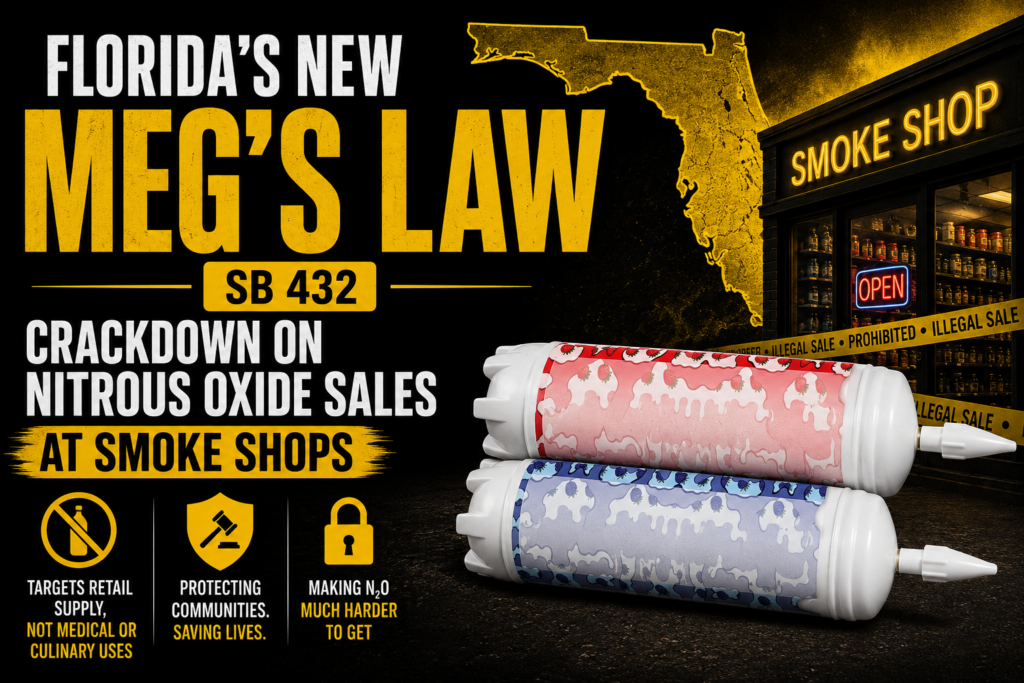
Florida has taken a major step to curb the recreational sale of nitrous oxide after Governor Ron DeSantis signed SB 432, commonly known as “Meg’s Law,” into law.
The legislation is designed to address a growing problem that many law enforcement agencies and public health officials say exploded in recent years: the widespread sale of large flavored nitrous oxide canisters in smoke shops and convenience stores under the guise of legitimate culinary use.
What Does Meg’s Law Do?
Rather than focusing primarily on individual users, Meg’s Law targets the retail supply chain.
The new law prohibits tobacco and nicotine dealers, including smoke shops and vape stores, from possessing, selling, or distributing nitrous oxide from their licensed premises. Grocery stores and supermarkets may continue selling legitimate food products that use nitrous oxide solely as a propellant, such as whipped cream products.
Supporters believe cutting off retail access at smoke shops will significantly reduce recreational availability while preserving legitimate culinary and medical uses.
What This Means for Florida Businesses
For smoke shops, vape stores, and other licensed tobacco retailers, the law represents a significant change in what products may legally be stocked and sold. Businesses that continue selling nitrous oxide after the law takes effect could face criminal penalties and regulatory action.
What This Means for Nitrous Oxide Users
For individuals who recreationally use nitrous oxide (N₂O), Meg’s Law is likely to have its biggest impact on availability rather than creating new criminal penalties for simple possession.
The law is primarily aimed at cutting off the retail supply chain by prohibiting licensed smoke shops, vape stores, convenience stores, and other tobacco or nicotine dealers from possessing or selling nitrous oxide from their licensed premises. Violating the law is a third-degree felony for the retailer or employee involved. Grocery stores and supermarkets may continue to sell legitimate food products that use nitrous oxide solely as a propellant, such as whipped cream canisters.
Is It Illegal to Possess Nitrous Oxide?
Meg’s Law does not create a new crime for simply possessing nitrous oxide as a consumer. However, Florida law has long made it illegal to possess or use nitrous oxide with the intent to become intoxicated or to distribute it for that purpose. Depending on the facts of a case, prosecutors may pursue charges under existing intoxicating substance laws if there is evidence the gas was being possessed or used recreationally.
Expect It to Become Much Harder to Find
The practical effect of Meg’s Law will likely be that recreational users can no longer walk into many Florida smoke shops or vape stores and purchase the large flavored nitrous oxide tanks that became increasingly common over the past several years.
By targeting retailers instead of individual users, lawmakers hope to reduce access to the products that were often marketed with colorful packaging and candy-like flavors despite being labeled “for culinary use only.” As legal retail outlets disappear, obtaining recreational nitrous oxide in Florida will likely become significantly more difficult.
How Did Nitrous Oxide Become So Common?
Nitrous oxide, often called “laughing gas,” has legitimate medical and culinary uses. Dentists have used it safely for decades as an anesthetic, and chefs use food-grade nitrous oxide to power whipped cream dispensers.
Florida law already prohibited selling nitrous oxide for the purpose of intoxication. However, retailers were able to exploit a significant loophole.
Manufacturers began producing oversized tanks marketed with colorful branding and flavors such as blue raspberry, cotton candy, and other candy-inspired varieties. These products were frequently labeled “for culinary use only,” allowing many smoke shops and vape stores to openly sell them despite their obvious recreational appeal.
Law enforcement officials argued that the products were rarely being purchased for restaurant use. Instead, they had become widely available to recreational users because enforcement against individual sales was difficult under existing law.
A Growing National Trend
Florida is not alone in tightening restrictions on recreational nitrous oxide sales. This website tracks states as they pass new N20 restrictions.
For years, nitrous oxide could be purchased openly in much of the United States, often marketed for culinary purposes despite being sold in increasingly large tanks with candy-inspired flavors and branding clearly aimed at recreational users. The rise of products like “Galaxy Gas” and viral social media trends dramatically increased awareness—and misuse—of nitrous oxide over the past several years.
As reports of serious injuries and deaths mounted, several states began passing laws aimed at restricting retail sales rather than banning legitimate medical or culinary uses.
According to legislative tracking compiled by advocates and publicly available state records:
- Florida has now enacted Meg’s Law, prohibiting smoke shops, vape stores, convenience stores, and other licensed tobacco or nicotine dealers from selling nitrous oxide products.
- Virginia passed similar legislation earlier in 2026 restricting retail sales.
- Oregon implemented new restrictions that took effect in January 2026.
- South Carolina is considering comparable legislation after receiving bipartisan support in the state Senate.
Rather than criminalizing legitimate uses of nitrous oxide, these laws generally focus on eliminating the retail market that developed around flavored canisters and oversized tanks sold for recreational inhalation. The goal is to make the products substantially less accessible while preserving their legitimate use in medical, dental, automotive, and commercial food-service settings.
Meg’s Law reflects a broader shift in how states are approaching nitrous oxide. Instead of focusing enforcement on individual users, lawmakers are increasingly targeting the businesses that supply products widely viewed as being marketed for recreational abuse.
Why Is It Called “Meg’s Law”?
The legislation is named after Meg Caldwell, a 29-year-old Central Florida woman whose family says she developed an addiction to nitrous oxide and died outside a smoke shop after using the substance.
Her family’s advocacy became the driving force behind the legislation, with lawmakers citing her case as evidence that the widespread retail availability of nitrous oxide had created an unintended public safety problem.
Health Risks of Nitrous Oxide Abuse
While many people mistakenly view nitrous oxide as relatively harmless because of its medical uses, chronic recreational inhalation can be extremely dangerous.
Medical experts warn that repeated misuse can lead to:
- Oxygen deprivation
- Permanent nerve damage
- Vitamin B12 deficiency
- Loss of coordination
- Brain injury
- Loss of consciousness
- In severe cases, death
Facing Criminal Charges?
Florida continues to update its criminal laws in response to emerging public safety concerns. Whether your case involves drug-related allegations, DUI charges, or another criminal offense, understanding how new laws affect your rights is critical.
The Ticket Clinic’s DUI & Criminal Division represents clients throughout Florida and can help explain your legal options when facing criminal charges.