A DUI Lawyer’s Guide to the First 48 Hours and What Happens Next
A DUI arrest in the Florida Keys can feel overwhelming, especially for someone who is visiting Monroe County and lives hours away—or outside Florida. The legal process begins immediately, and decisions made during the traffic stop and within the first 24 to 48 hours can affect your driver’s license, criminal case and future.
A Florida DUI arrest may create two separate legal proceedings. One is a criminal case handled through the Monroe County court system. The other is an administrative proceeding involving your Florida driving privileges or, for an out-of-state driver, the driving privilege that Florida controls within the state.
This guide explains what generally happens during and after a DUI arrest in Key West, Marathon, Key Largo, Islamorada or elsewhere in the Florida Keys. It also covers important deadlines and the steps you can take to protect yourself or help a loved one.
Important: You generally have only 10 days from the date of the arrest or issuance of the notice of suspension to request review of an administrative driver’s license suspension. Waiting for your first Monroe County court date could cause you to miss this deadline.
Step 1: The Florida Keys DUI Stop and Investigation
Many DUI arrests in Monroe County begin with a traffic stop after an officer alleges that a driver was speeding, weaving, failing to maintain a lane, driving without headlights or committing another traffic violation. Other investigations may begin at a DUI checkpoint, after a crash or when an officer approaches a stopped or parked vehicle.
DUI investigations in the Florida Keys may be conducted by agencies including:
- Monroe County Sheriff’s Office
- Key West Police Department
- Key Colony Beach Police Department
- Florida Highway Patrol
- Florida Fish and Wildlife Conservation Commission
Stops and crash investigations frequently occur on U.S. Highway 1 and the Overseas Highway, which provide the primary roadway connection through the Florida Keys. Investigations may also occur on North Roosevelt Boulevard, South Roosevelt Boulevard, Truman Avenue, Flagler Avenue, Card Sound Road, Key Deer Boulevard and other roads throughout Monroe County.
The unique layout of the Keys can become relevant in a DUI case. U.S. 1 includes long stretches of two-lane roadway, changing speed limits, bridges, limited shoulders and areas with heavy tourist traffic. Road construction, poor lighting, weather, unfamiliar surroundings and attempts to follow directions can sometimes affect how a person drives.
During the investigation, the officer may ask where you were coming from, whether you consumed alcohol or drugs and how much you consumed. The officer may also look for alleged signs of impairment, including:
- Bloodshot or watery eyes
- Slurred speech
- The odor of an alcoholic beverage
- Difficulty locating a driver’s license or other documents
- Problems exiting the vehicle
- Swaying or difficulty balancing
- Confusion or delayed responses
These observations are subjective and do not always prove impairment. Fatigue, anxiety, allergies, injuries, medical conditions, prescription medication, sun exposure, dehydration and environmental factors can sometimes produce similar symptoms.
Remain Calm and Avoid Unnecessary Statements
Remain calm and respectful during the stop. Provide your driver’s license, vehicle registration and proof of insurance when legally required. Avoid arguing with the officer or physically resisting.
You should also avoid volunteering unnecessary information. Statements made during a roadside investigation can appear in the arrest report and may later be used by prosecutors.
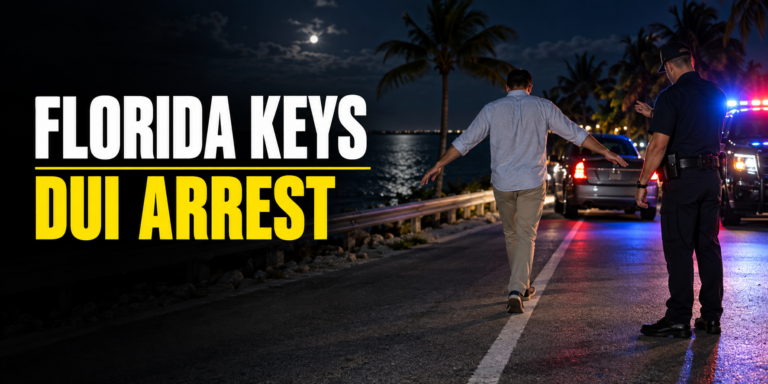
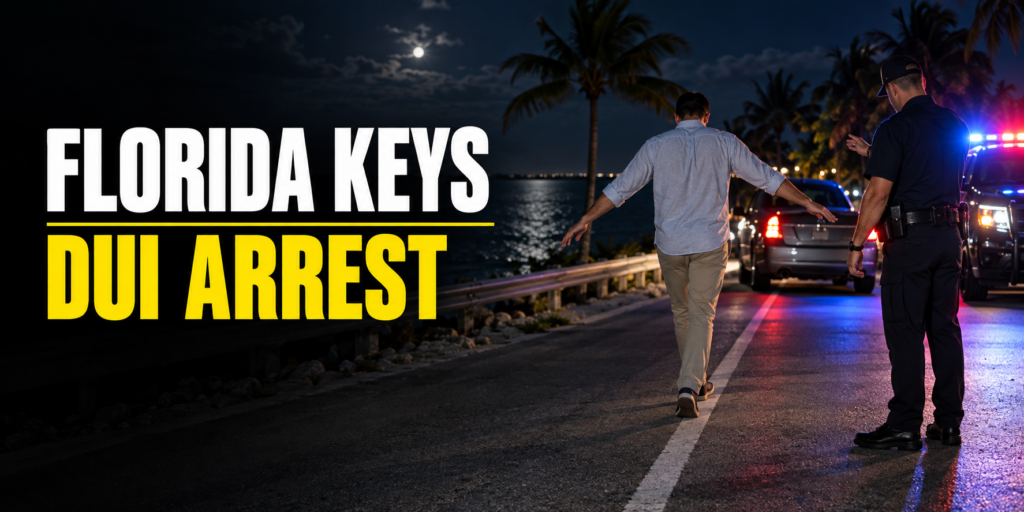
Roadside Field Sobriety Exercises
An officer may ask you to perform roadside field sobriety exercises. Common exercises include:
- Horizontal gaze nystagmus exercise
- Walk-and-turn exercise
- One-leg stand exercise
- Finger-to-nose exercise
Performance may be affected by physical injuries, age, footwear, traffic, lighting, wind, rain, uneven pavement, gravel, narrow shoulders, confusing instructions or nervousness. Body-camera or dashboard-camera footage may be important when determining whether the exercises were properly explained and administered.
Conditions along the Overseas Highway and other Keys roads may also matter. A field sobriety exercise conducted beside fast-moving traffic, on a sloped shoulder or in poor lighting may not provide the same conditions as an exercise performed on a flat, well-lit surface.
Step 2: Arrest and Chemical Testing
If an officer believes there is probable cause to make an arrest, you may be handcuffed and transported for processing. A Florida DUI arrest may involve a request for a breath, blood or urine sample, depending on the allegations and circumstances.
Breath testing generally occurs after an arrest. The testing process should include an observation period and other procedures intended to protect the reliability of the reported result.
A reported breath-alcohol level of .08 or higher does not automatically prevent the case from being challenged. A Florida Keys DUI attorney may review:
- The legality of the initial traffic stop
- Whether sufficient probable cause existed for the arrest
- Whether the required observation period was completed
- The breath-test operator’s qualifications
- The instrument’s inspection and maintenance records
- Whether the test was administered properly
- Whether the machine produced reliable results
- Medical or environmental factors that may have affected the result
- The time between the alleged driving and the chemical test
What Happens if You Refuse a Breath or Urine Test?
Under current Florida law, refusing a lawful breath or urine test can result in administrative and criminal consequences.
A first refusal generally results in a one-year driver’s license suspension and may be prosecuted as a second-degree misdemeanor. If the person has a qualifying prior refusal, the administrative suspension may last 18 months, and the refusal may be prosecuted as a first-degree misdemeanor.
Prosecutors may also attempt to use evidence of a refusal in the criminal DUI case. An attorney can examine whether the requested test was lawful, whether the required warning was given and whether the alleged refusal was clear and legally valid.
Florida’s implied-consent requirements are addressed in Florida Statute §316.1932.
Blood Testing After a Crash
A DUI investigation involving a crash, injury or medical treatment may include a blood sample. An attorney may review whether the blood draw was legally authorized, how the sample was collected and stored, whether the chain of custody was documented and whether the laboratory followed proper testing procedures.
Step 3: Booking After a DUI Arrest in Monroe County
People arrested for DUI in the Florida Keys may be processed at a Monroe County detention facility serving the area where the arrest occurred. Because Monroe County stretches more than 100 miles through the Keys, the booking location may depend on whether the arrest occurred in the Lower, Middle or Upper Keys.
The Monroe County Sheriff’s Office operates detention facilities and law-enforcement locations throughout the county. Facility assignments and procedures can change, so family members should confirm the person’s location through the Sheriff’s Office rather than assuming the person was taken to Key West.
View Monroe County Sheriff’s Office locations.
The booking process may include:
- Fingerprinting and photographs
- Recording personal and identifying information
- Medical screening
- Inventorying personal belongings
- Reviewing the charges and any outstanding warrants
- Placement in a holding area
- Determining release or bond eligibility
Processing and release times vary. The length of time a person remains in custody can depend on when the arrest occurred, facility volume, the alleged alcohol level, prior criminal history, additional charges, medical concerns and whether the incident involved a crash or injury.
Do not assume that every first-time DUI arrest will result in immediate release. Release conditions depend on the allegations, criminal history and applicable court procedures.
Step 4: Bond, Release or First Appearance
After booking, one of several things may happen.
Release on Recognizance
Some defendants may be released on their own recognizance without posting a monetary bond. Eligibility can depend on the charges, criminal history, ties to the community and other relevant factors.
Posting Bond
If a monetary bond is required, it may need to be posted before the person can be released. Additional restrictions or conditions may also apply after release.
First Appearance
A person who remains in custody will generally be brought before a judge for a first appearance. At this hearing, the judge may:
- Review whether probable cause exists
- Confirm the charges
- Set or modify bond
- Establish conditions of release
- Restrict alcohol or controlled-substance use
- Address driving or pretrial-supervision conditions
First appearance is not a trial. The judge generally does not decide whether the defendant is guilty or innocent at this stage.
Step 5: What to Do During the First 24 to 48 Hours
The first two days after a Florida Keys DUI arrest can be especially important. Driver’s license deadlines begin quickly, and relevant evidence may need to be identified and preserved.
Contact a Florida Keys DUI Lawyer
Early involvement allows a lawyer to begin evaluating the traffic stop, arrest, chemical testing and available video. An attorney can also identify immediate deadlines and explain what may happen in the Monroe County court system.
Contact a Florida Keys DUI lawyer serving Monroe County.
Protect Your Driver’s License: The 10-Day Deadline
You generally have only 10 days from the date of the arrest or issuance of the notice of suspension to request formal or informal review of an administrative driver’s license suspension. Depending on eligibility, another option involving restricted driving privileges may also be available.
The administrative suspension is separate from the criminal DUI case. Waiting for your first Monroe County court date could cause you to miss the deadline for addressing the administrative suspension.
Review the notice and temporary driving permit provided after the arrest carefully. Do not drive unless you are certain that your license or temporary permit remains valid.
Information about Florida administrative DUI suspensions is available through the Florida Department of Highway Safety and Motor Vehicles.
Out-of-State Drivers Arrested in the Florida Keys
Many people arrested for DUI in the Florida Keys are visiting from another state. Florida may take action against the person’s privilege to drive in Florida, and the person’s home state may take separate action after receiving notice of the arrest or suspension.
An out-of-state driver should not assume that leaving Florida makes the case or license issue disappear. Court appearances, administrative deadlines and release conditions may still apply. A lawyer can determine whether certain court proceedings can be handled without the defendant returning to Monroe County.
Do Not Discuss the Case Publicly
Avoid discussing the facts of the case with:
- Law-enforcement officers without legal advice
- Other people in the detention facility
- Friends or relatives on recorded jail calls
- Coworkers or employers unless necessary
- People on social media
Jail calls are generally recorded. Statements, messages, photographs and social-media posts may later become evidence.
Write Down What Happened
As soon as possible, write down everything you remember, including:
- Where and when the stop occurred
- The nearest mile marker, bridge, intersection or recognizable landmark
- The reason the officer gave for stopping you
- What the officer asked and what you said
- What happened before you drove
- When and what you ate or drank
- Whether you took any prescription or over-the-counter medication
- How the field sobriety exercises were explained
- Road, shoulder, lighting and weather conditions
- Whether body cameras or dashboard cameras were present
- Whether passengers or other witnesses were present
- How long you waited before chemical testing
Small details can become important when police reports and video are reviewed. Memories can fade quickly, so prepare these notes while the events are still fresh.
Preserve Potential Evidence
Save anything that may help establish the timeline or circumstances surrounding the arrest, including:
- Restaurant, bar, hotel or marina receipts
- Credit-card transactions
- Text messages
- Ride-share or taxi records
- Photographs and videos
- Phone location history
- Hotel reservation information
- Boat rental or marina records
- Names and contact information for witnesses
- Medical records and prescription information
Surveillance video from hotels, resorts, restaurants, bars, marinas, parking lots and nearby businesses may be deleted automatically after a short period. A lawyer may be able to identify and request preservation of relevant footage.
Step 6: Helping Someone Arrested for DUI in the Florida Keys
If a family member, friend or traveling companion has been arrested for DUI in Key West, Marathon, Key Largo, Islamorada or elsewhere in Monroe County, there are several practical steps you can take.
Confirm Where the Person Is Being Held
Use the Monroe County Sheriff’s Office current-arrest information or contact the Sheriff’s Office to confirm the person’s location and booking status.
Search current Monroe County arrests.
Determine Whether Bond Is Required
Find out whether the person qualifies for release, whether a monetary bond has been set and whether any special release conditions apply.
Limit Conversations About the Arrest
Jail calls are generally recorded. Avoid asking the arrested person to describe what happened, how much they drank, whether they used drugs or what they told the officer.
Focus the conversation on immediate needs, including release arrangements, medication, hotel accommodations, transportation, vehicle retrieval and contacting an attorney.
Gather Important Documents
If possible, help preserve:
- Booking and release paperwork
- The DUI citation
- Driver’s license documents
- Vehicle tow or impoundment information
- Rental-car documents
- Insurance documents
- Hotel and travel records
- Receipts and potential witness information
Plan Safe Transportation After Release
The person may not be legally permitted to drive after release. Arrange for a sober driver, taxi, ride-share service or other transportation. If the vehicle was rented or impounded, confirm the rental company’s or tow operator’s requirements before attempting to retrieve it.
Step 7: What Happens Next in a Monroe County DUI Case?
After release, the criminal case proceeds through Florida’s Sixteenth Judicial Circuit. Most misdemeanor DUI cases are handled by the County Criminal Division. Felony DUI cases are generally handled by the Circuit Criminal Division.
Because Monroe County covers the Lower, Middle and Upper Keys, proceedings may be assigned to one of three principal courthouse locations:
Freeman Justice Center
302 Fleming Street
Key West, FL 33040
Marathon Courthouse
3117 Overseas Highway
Marathon, FL 33050
Plantation Key Government Center
88770 Overseas Highway, Suite 1
Tavernier, FL 33070
The citation, release paperwork or official court notice should identify the correct courthouse, courtroom and appearance date.
View official Sixteenth Judicial Circuit courthouse locations.
Arraignment
At arraignment, the defendant is formally advised of the charge and a plea is entered. Depending on the circumstances and representation, an attorney may be able to handle certain preliminary matters without the defendant personally appearing.
Never miss a scheduled court date unless your lawyer or the court has confirmed that your appearance is excused. This is especially important for visitors who have returned home after an arrest in the Keys.
Discovery and Evidence Review
The defense may obtain and review evidence such as:
- Police reports
- Body-camera and dashboard-camera footage
- Dispatch and 911 records
- Field sobriety exercise video
- Breath-test records
- Blood or urine laboratory results
- Photographs
- Crash reports
- Witness statements
- Hotel, restaurant or business surveillance footage
Pretrial Hearings and Motions
Depending on the evidence, an attorney may file motions challenging the traffic stop, arrest, statements, chemical testing or other evidence. A motion to suppress may ask the court to prevent unlawfully obtained evidence from being used at trial.
Negotiation, Trial or Another Resolution
A case may be resolved through dismissal, negotiation, a plea, participation in an eligible program or trial. The available options depend on the evidence, prior history, alleged alcohol level, aggravating circumstances and policies of the State Attorney’s Office for the Sixteenth Judicial Circuit.
Eligibility for any diversion or alternative-resolution program is not automatic. Program availability and requirements can change. An attorney can determine whether a particular option may apply to the case.
If an acceptable resolution cannot be reached, the defendant has the right to contest the charge at trial.
How a Florida Keys DUI Lawyer Evaluates the Evidence
A DUI arrest does not automatically mean the state can prove its case. A defense attorney may investigate:
- Whether the officer had a lawful reason for the traffic stop
- Whether the driver was operating or in actual physical control of the vehicle
- Whether sufficient probable cause existed for the arrest
- How field sobriety exercises were explained and administered
- Whether roadside conditions affected the exercises
- Whether physical or medical conditions affected performance
- Whether breath-testing procedures were followed
- Whether blood or urine samples were lawfully obtained
- Whether samples were properly collected, stored and tested
- Whether officer statements match the video evidence
- Whether important evidence is missing
- Whether the defendant’s constitutional rights were violated
Potential defenses depend on the individual facts. No single defense applies to every Monroe County DUI case, and no particular result can be guaranteed.
What Penalties Can Follow a Florida DUI Conviction?
Under Florida Statute §316.193, a first DUI conviction can result in:
- A fine of $500 to $1,000
- Up to six months in jail
- Probation
- Driver’s license revocation
- DUI school and a substance-abuse evaluation
- Community service
- Vehicle impoundment or immobilization
- Court costs and additional expenses
Enhanced penalties may apply if the alleged alcohol level was .15 or higher, a person under 18 was in the vehicle, the incident caused property damage or injury, or the driver has previous DUI convictions.
A DUI can also affect employment, professional licenses, insurance costs, travel, commercial driving privileges and other parts of a person’s life.
Why Local Experience Matters in a Monroe County DUI Case
Florida’s DUI statutes apply throughout the state, but Monroe County presents unique logistical and procedural issues. The county extends across the Florida Keys, and court, booking and law-enforcement responsibilities may depend on whether the incident occurred in the Lower, Middle or Upper Keys.
Monroe County cases may involve:
- Investigations by the Monroe County Sheriff’s Office
- Key West Police Department arrests
- Key Colony Beach Police Department investigations
- Florida Highway Patrol stops on U.S. 1 and the Overseas Highway
- Florida Fish and Wildlife Conservation Commission involvement
- Booking at a detention facility serving the relevant area of the Keys
- Proceedings in Key West, Marathon or Plantation Key
- Prosecution through the State Attorney’s Office for the Sixteenth Judicial Circuit
An attorney familiar with the Florida Keys and Monroe County can evaluate how those local procedures may apply to the specific case.
Frequently Asked Questions About Florida Keys DUI Arrests
How long will someone stay in jail after a DUI arrest in the Florida Keys?
Processing and release times vary. Some people arrested for a first-time, non-aggravated DUI may be released after several hours, while others may remain in custody longer. Timing depends on facility volume, release eligibility, additional charges, medical issues and whether a first appearance is required.
Where are DUI arrests in Monroe County processed?
The booking location may depend on whether the arrest occurred in the Lower, Middle or Upper Keys. The Monroe County Sheriff’s Office operates detention services across the county. Family members should use the Sheriff’s Office arrest search or contact the agency to confirm where the person is being held.
Where will a Monroe County DUI case be heard?
Monroe County cases proceed through Florida’s Sixteenth Judicial Circuit. Depending on where the arrest occurred and how the case is assigned, proceedings may take place at the Freeman Justice Center in Key West, the Marathon Courthouse or the Plantation Key Government Center in Tavernier.
What happens to my driver’s license after a Florida Keys DUI arrest?
The arrest may result in an administrative driver’s license suspension. A person generally has only 10 days from the arrest or issuance of the notice of suspension to request review or evaluate another available option. This administrative proceeding is separate from the criminal case.
What if I live outside Florida?
Florida may suspend your privilege to drive within the state, and your home state may impose separate consequences. Leaving Florida does not cancel the criminal case, administrative deadlines or scheduled court dates. Speak with an attorney before assuming that you must return for every hearing or that no further action is required.
Can a Florida Keys DUI charge be reduced or dismissed?
Depending on the facts, a DUI charge may be challenged, reduced or dismissed. Potential issues may involve the legality of the stop, probable cause, field sobriety exercises, chemical testing, missing video, medical conditions or conflicting evidence. No particular result can be guaranteed.
Can I fight a DUI if my breath result was over .08?
Yes. A reported breath result does not prevent someone from challenging the legality of the stop, the arrest, the operation of the testing equipment or the procedures used to obtain the result.
Can an attorney appear for me if I do not live in the Florida Keys?
An attorney may be able to handle certain preliminary proceedings without the defendant appearing personally, depending on the charge, judge and stage of the case. Personal attendance may still be required for particular hearings or trial. Never miss a court date unless your attorney or the court has confirmed that your appearance is excused.
The Bottom Line: Act Quickly After a Florida Keys DUI Arrest
A DUI arrest in the Florida Keys can move quickly from the roadside investigation to booking, release, driver’s license proceedings and court. Important decisions are made early, and waiting can make it harder to preserve evidence or protect the options available to you.
The DUI and Criminal Division of The Ticket Clinic has defended Florida DUI and traffic cases since 1987. Our Florida Keys team represents clients throughout Monroe County, including Key West, Stock Island, Big Coppitt Key, Big Pine Key, Marathon, Key Colony Beach, Islamorada, Tavernier, Plantation Key, Key Largo and surrounding communities.
Our attorneys examine the traffic stop, roadside conditions, field sobriety exercises, chemical testing, videos, police reports and local court procedures to develop a defense based on the specific evidence.
A DUI arrest is not a conviction. Contact our Florida Keys team as soon as possible to discuss the case and the deadlines that may apply.
Call The Ticket Clinic’s DUI and Criminal Division:
800-625-5232Speak With a Florida Keys DUI Lawyer
This article provides general information and does not constitute legal advice. Every case is different, and previous results do not guarantee a similar outcome.